
PHP emergency patches: compare patching cost with downtime
Updated October 21, 2026 · first published October 21, 2026
On October 21, 2026, the NSA advised organizations using PHP to prepare for an immediate update addressing two critical vulnerabilities, and to take affected systems offline if they cannot be updated or fully mitigated. PHP maintainers published fixes for CVE-2026-109618 and CVE-2026-109619. The business decision is concrete: find every PHP runtime, apply the correct vendor patch, and compare any unavoidable delay with the service’s cost of downtime.
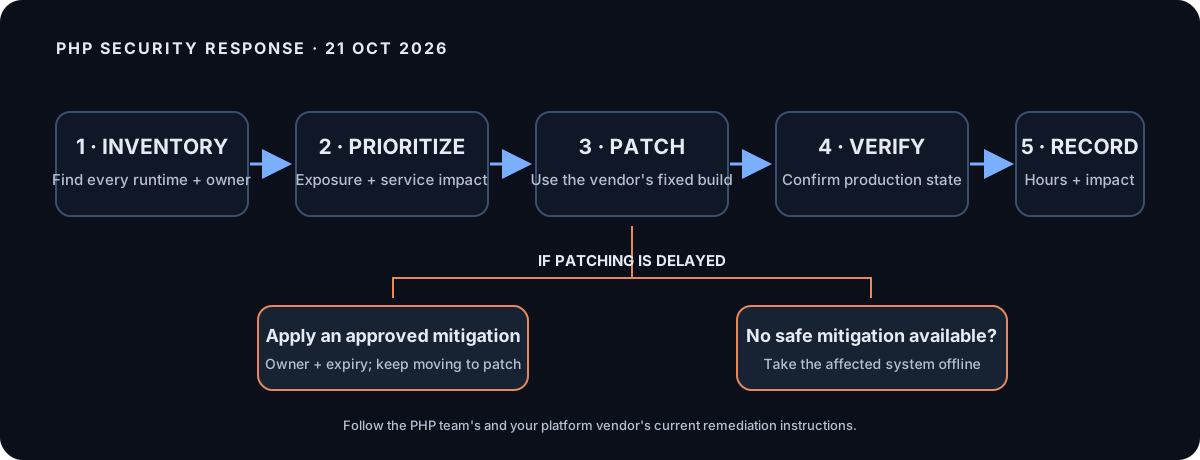
This does not mean taking every PHP website offline indiscriminately. It means establishing which systems run PHP, who owns them, whether they receive untrusted requests, and how quickly they can be patched. PHP’s advisory covers installations serving web requests, including PHP-FPM, Apache mod_php, php-cgi, FrankenPHP, and LiteSpeed. It identifies mod_php as the highest-risk configuration because a demonstrated unauthenticated request can trigger exploitation before application code runs.
What the PHP advisories say
Both issues are remote-code-execution vulnerabilities. CVE-2026-109618 concerns out-of-memory handling that can leave PHP request data in an invalid state. CVE-2026-109619 concerns stale request-owned state that can be used later by the same worker before it is reset.
The upstream fixed releases are PHP 8.2.35, 8.3.36, 8.4.27, and 8.5.12. Linux distributions and long-term-support vendors may include the fixes in packages with different version labels. Confirm the patched package with your platform vendor instead of comparing version strings alone. For an older or vendor-maintained branch, follow that vendor’s advisory and remediation instructions.
Make the response queue visible
Manage this as a short incident queue rather than an unowned infrastructure chore. For every system, record the runtime and accountable owner; the host, container, or managed platform and PHP version; whether it handles internet-facing or other untrusted requests; the customer journey or internal process that would fail if it stopped; the tested vendor patch, deployment window, rollback plan, and executor; and any interim control, with its documented source, owner, and expiry.
Prioritize internet-facing systems and configurations PHP identifies as higher risk. Do not assume a framework, content-management system, or hosting provider updated the runtime: verify the actual package or service status.
Compare patching and downtime on the same basis
For each service, estimate every feasible response over the same time window:
Response cost = engineering and operations hours + change or vendor fees + expected downtime impact + expected residual incident impact.
Downtime impact is the direct cost of deliberately pausing a service: lost contribution margin, missed transactions, service credits, and manual workarounds. Residual incident impact is the probability-weighted cost of leaving a system exposed and unpatched, including investigation, recovery, customer response, and legal or contractual work. Keep the two terms separate. Do not present a speculative breach probability as a measured fact; show a range and its assumptions.
For example, a team estimates that an emergency patch and validation take 12 staff-hours at a fully loaded $100 per hour, plus a two-hour maintenance window with an estimated $2,000 contribution-margin impact. The known direct cost is $3,200. A four-hour outage to avoid patching immediately would cost about $4,000 at the same revenue rate, before support costs or customer credits. These figures do not quantify breach risk; they make the known operating trade-off comparable. Replace them with the service’s own figures.
If a safe update cannot be applied promptly, the NSA advises taking the system offline until it is fully mitigated. The UK National Cyber Security Centre also recommends patching, applying PHP’s additional hardening steps, using PHP’s temporary mitigations when an update is not immediately possible, and considering offline operation when mitigations cannot be applied in time. Treat mitigation as a bridge to a fixed version, not a permanent substitute.
What finance and engineering should track
Use a temporary incident cost code or tag so response work does not disappear into general infrastructure spend. Track engineering, SRE, and security hours by service; emergency hosting, support, or vendor charges; planned maintenance separately from unplanned downtime; customer credits, refunds, and manual-workaround costs; and the date and evidence for each runtime’s verified patched state.
This separates the cost of reducing exposure from the cost of the underlying software estate and gives leadership a defensible record of why a service was patched, mitigated, or paused.
Prepare before the next urgent advisory
The expensive part of an emergency vulnerability is often not the code change. It is discovering that no one can say where a runtime is deployed, which team owns it, or which vendor package contains the fix. Keep a current runtime and service-owner inventory, and rehearse the decision to patch, mitigate, or take a service offline before the next urgent advisory arrives.
Frequently asked questions
Which PHP versions fix CVE-2026-109618 and CVE-2026-109619?
The upstream fixed releases are PHP 8.2.35, 8.3.36, 8.4.27, and 8.5.12. Vendor packages can use different version labels, so confirm the fix with your Linux distribution, hosting platform, or other vendor.
Should a business take every PHP website offline?
No. First inventory PHP runtimes, ownership, exposure, business impact, and patch paths. Prioritize internet-facing and PHP-identified higher-risk configurations. The NSA advises taking an affected system offline if it cannot be updated or fully mitigated.
How should finance compare emergency patching with downtime?
Compare all feasible responses over the same time window, adding engineering and operations hours, change or vendor fees, expected downtime impact, and expected residual incident impact. Keep downtime and probability-weighted incident costs separate and show assumptions as ranges.
Are PHP mitigations a replacement for installing a fix?
No. PHP’s temporary mitigations and additional hardening steps can help when an update is not immediately possible, but the guidance treats mitigation as an interim bridge to a fixed version. If the system cannot be updated or fully mitigated, the NSA advises taking it offline.
Sources
- NSA: Advisory on PHP updates, October 21, 2026
- PHP: Security advisory and fixed versions, October 21, 2026
- PHP Security Advisory GHSA-w8hw-w9fx-j79w (CVE-2026-109618)
- PHP Security Advisory GHSA-6wmf-4rv5-p3rp (CVE-2026-109619)
- UK NCSC: Critical security issue affecting PHP
Related
Want this applied to your stack? Bring the provider bills, gateway logs, and top workflows; we will map the cost drivers and savings path. Book a free audit →